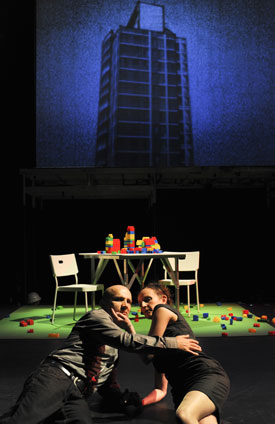
 One of the most spine-tingling moments of The Table of Knowledge is when the roof of the theatre seems to give way and, bricks fall to the floor. On stage, the bricks are Lego, symbolic, the destruction not entirely real – but, we are reminded, the events that this play documents are altogether real, they nearly tore an entire city apart, and some of them took place right across the street from the theatre.
The Table of Knowledge is based on the investigation conducted by the Independent Commission Against Corruption’s (ICAC) into local property developers and the staff and elected officials of Wollongong City Council. We are reminded at the beginning of the play that Wollongong is not the first city to have had a corrupt council: what makes the Wollongong story so newsworthy and so juicy is the sex scandal tacked onto it – Beth Morgan, a council planning officer, was engaged in sexual relationships with several major property developers. These private relationships had the power to change the face of a city.
Version 1.0 and Merrigong Theatre Company’s show is not a classic political thriller, although it would be very easy to turn the story into one – it has sex, deception, con men, clandestine meetings in car parks, phone taps, dirty deals, and death threats. It has all the ingredients for something in the noir genre, but this is not the direction the show goes at all. Instead, nearly all the script is taken verbatim from the ICAC reports. This type of theatre owes a lot to the work of Brecht – the focus is not on the actors’ portrayal of the characters or even a linear narrative. It is not sensationalised or adorned. It is raw theatre – the players in the scandal literally allowed to speak for themselves.
In one sense, this style of theatre-making does not add much to the conversation. At the beginning of the play, performer David Williams announces that some of the audience will know some things, others may know other things, and together, they will learn some things. Realistically, there is nothing in this play that audience members could not find out on their own (provided they were willing to slog through reams and reams of ICAC documents). However, what this play does do is encourage critical engagement with the story – a story which, for those of us who live in Wollongong, is something that is still a massive part of public life. Serendipitously for this production, its season coincides with the first council elections since the scandal. One of the main players, Rod Oxley (played by Williams in the show), is running for Lord Mayor.
Unsurprisingly, Oxley raised concern about the production (although the script was kept secret right up until opening night). At the beginning of the play, there is a moment where the actors leave the theatre and the audience watch them via video pay someone off so that the show can go on. It is a reminder that the events shown in the play are not just current but relevant – and that information can be dangerous.
As a piece of theatre, The Table of Knowledge certainly has its flaws – there was no need for the intermission, for example. In the Q&A afterwards, the performers expressed the desire to tour the show – and while similar corruption scandals have happened in other local governments, I think the play would lose a lot of its impact outside Wollongong. For me, a huge part of the power of the play came from the fact that I knew all the places involved. I’ve been to that kebab kiosk. I’ve had coffee at Nonabel’s. The stage itself – the Gordon Theatre at IPAC – is intensely familiar, the site of the many Wollongong Eisteddfods of my childhood. While the story would still be a good one outside Wollongong, I can’t see how it would be as powerful for people who have not lived the scandal.
However, I would still recommend this show to people unfamiliar with the ICAC investigation and the tawdry tale of Wollongong’s corrupt council. The Table of Knowledge is a raw portrayal of the scandal that rocked a region without resorting to cheap sensationalising. It is frank acknowledgement that the personal can affect the political in not just an intense but a tangible way, a call for more critical thinking about and engagement with public affairs. Fantastic theatre.
A version 1.0 and Merrigong Theatre Company co-production
THE TABLE OF KNOWLEDGE
Venue: Illawarra Performing Arts Centre | 32 Burelli St Wollongong, Nsw
Dates: 30 August – 18 September, 2011
Tickets: $56 – $20
Bookings: (02) 4224 5999 | www.merrigong.com.au
Sydney Reviews
Table of Knowledge | version 1.0 and Merrigong Theatre Company
- Details
- Jodi McAlister
Most read Sydney reviews
The Lark | Hey Dowling
Noni Hazlehurst brings Rose and The Lark to colourful and compelling life in this one-woman show.
Pride & Prejudice* (*sort of) | Neil Gooding Productions & Woodward Productions
This rollicking musical take on Jane Austen’s beloved novel is a side-splitting crowd pleaser.
Heartbreak Hotel | EBKM
Heartbreak Hotel invites its audience into an intimate portrait of the universal and isolating experience of heartbreak.
Current | Sydney Dance Company
While Bonachela’s work is, as always, dreamily lovely, for me the highlights were absolutely the three commissioned choreographers: Azzam Mohamed, Jenni Large and Raghav Handa.
The Gospel According to Paul – The Second Coming | Soft Tread Productions
The Gospel According to Paul is meticulously crafted entertainment. It’s uplifting without pulling any punches.
The Gospel According to Paul is meticulously crafted entertainment. It’s uplifting without pulling any punches.

While Bonachela’s work is, as always, dreamily lovely, for me the highlights were absolutely the three commissioned choreographers: Azzam Mohamed, Jenni Large and Raghav Handa.